Skip to content


Waterproof Work Jackets: The Complete UK Buying Guide
- by Mike Johnson

There is a gap between a jacket that keeps rain off for twenty minutes and one that keeps you dry through a ten-hour shift in November. Both get sold as waterproof.
This guide explains what actually separates them, covers the four types of waterproof work jacket and when each is the right answer, and names specific products with prices from £7.75 to £227 so you can match the spend to how much of your week is spent outdoors.
Waterproof or Water Resistant: The First Thing to Check
These are not the same, and the distinction costs people money every autumn.
Water resistant means the outer fabric has a surface treatment that makes rain bead and run off. It handles a shower. Under sustained rain the fabric wets out, the treatment gives up, and water soaks through. Softshells are usually water resistant rather than waterproof.
Waterproof means a membrane bonded behind the outer fabric physically blocks water, with the seams sealed so it cannot get in at the stitching. This is what survives a full day of rain.
If a product is described as water repellent, showerproof or weather resistant, it is not waterproof. The Stormtech Crew Bonded Softshell (CXJ-1, £62.72) is honestly labelled water repellent, for instance - a good jacket, but not one for a wet shift.
The practical test before buying: does the description say waterproof, and does it mention taped or welded seams? Waterproof fabric with unsealed seams is not a waterproof garment, because every stitch line is a row of holes.
The Four Types
Rain Jackets and Hardshells
A shell with no insulation, designed to go over whatever you are already wearing. Light, packable, and the most genuinely waterproof category.

This is what you want if your exposure to rain is intermittent, or if you layer underneath and want to control warmth separately.
Insulated and Winter Jackets
Waterproof outer plus padding or quilting built in. One garment instead of two, warmer, bulkier, and harder to regulate if the work is physical.
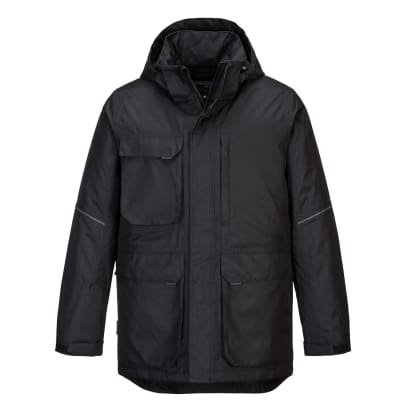
Right for cold, static or low-movement work. Wrong if you are carrying materials and generating your own heat.
3-in-1 Systems
A waterproof outer shell with a zip-out fleece or quilted liner. Wear the shell alone in mild wet weather, the liner alone indoors or in dry cold, and both together in winter.

For most people this is the smartest single purchase, because one jacket covers three seasons.
Softshells and Fleeces
Not waterproof, but worth understanding because they are frequently bought by mistake. A softshell is wind resistant, water resistant, breathable and far more comfortable to work in than a shell. A fleece is a warmth layer with no weather protection at all.

Both are mid-layers or dry-weather outers. Neither replaces a waterproof.
Budget: Under £25
At this end you are buying a basic shell. Fine for occasional use, not built for daily site abuse.

- The Portwest Basic Budget Waterproof Rain Jacket (S440, from £7.75) is the cheapest waterproof here. Keep one in the van.
- The Portwest Iona Classic Lightweight Waterproof Rain Jacket (F440, £12.46) is a slight step up and still barely registers on cost.
- The Result Core Fleece Lined Lightweight Waterproof Jacket (R203X, £20.86) adds a fleece lining, which makes it usable in cold rain rather than just rain.
- The Portwest Calais Waterproof Bomber Jacket (S503, £21.35) has a cleaner, more uniform-friendly cut - useful if you are client-facing or want something that does not look like site kit.
- The Result Core Midweight Waterproof Hooded Long Jacket (R206X, £21.00) gives longer coverage over the seat and thighs, which matters more than people expect when sitting on wet surfaces or in open vehicles.
- The Result Waterproof Midweight Multi-Function Work Jacket (R67X, £22.75) and the Result Core Ladies Waterproof Windproof Channel Jacket (R221F, £22.75) cover the same ground, the R221F being one of the few women's-cut waterproofs in the range.
Mid-Range: £27 to £60
This is where most regular outdoor workers should be looking, and where the 3-in-1 systems start.

- The Result Reversible Fleece Lined Stormdri 4000 Waterproof Jacket (R160X, £27.00) is reversible, so one side can be plain for smarter work.
- The Portwest TK2 Limax Insulated Ripstop Waterproof Hooded Jacket (S505, £28.35) brings insulation and ripstop fabric together at a sensible price. Ripstop uses a reinforced grid weave that stops small tears spreading - genuinely useful around wire, timber and scaffold.
- The Result Workguard Sabre Padded Pilot Jacket (R300X, £31.85) is waterproof, windproof and padded in a pilot cut. The longer Sabre Padded Work Coat (R301X, £37.45) is the same idea with more coverage.
- The Beeswift Mercury Waterproof Work Jacket (MUJ, £32.20) and the warmer Mercury Bomber (MUBJ, £35.00) are solid multi-pocket workhorses.
- The Portwest Sealtex Waterproof Breathable Air Jacket (S350, £32.90) is the breathable option at this level. If your work is physical, breathability matters as much as waterproofing - a sealed, non-breathable jacket leaves you wet from the inside regardless of how well it blocks rain.
- The Portwest Outcoach Waterproof Breathable Mesh Lined Jacket (S555, £34.58) and the Portwest Ripstop Work Parka (S562, £36.12) extend that with mesh lining and parka length respectively.
- The Apache ATS Waterproof Padded Work Jacket (ATSWPJ, £37.00) and the Apache Welland Waterproof Work Jacket (£39.99) are the Apache options, both well specified for the money.
- The Portwest DX4 Hooded Stretch Waterproof Windproof Ripstop Softshell (DX474, £41.30) is unusual - a softshell construction that is genuinely waterproof rather than just resistant. Good compromise if you find hardshells restrictive.
- The Portwest 4-in-1 Bomber with zip-out sleeves, bodywarmer and fur liner (F465, £41.93) is the most configurable jacket in the range.
- The Portwest Argo Classic 3-in-1 with detachable fleece liner (S507, £42.70), the Portwest Aviemore 3-in-1 (S570, £45.66) and the Portwest Orkney Waterproof Breathable 3-in-1 (S532, £51.52) are the three main 3-in-1 systems. The Orkney is the best specified of the three.
- The Regatta Defender III 3-in-1 (TRA130, £49.21) is the Regatta equivalent.
- The Beeswift Pembroke Flex Padded Waterproof Stretch Rain Jacket (SFPRJBLGY, £49.00) adds stretch to a padded waterproof, which helps considerably if the work involves reaching and climbing.
- The Result Workguard Platinum Managers Jacket (R307M, £48.93) uses foil-based insulation for warmth without bulk.
- The Portwest DX4 Insulated Waterproof Winter Jacket with 4-Way Stretch (DX460, £57.68) and the Portwest KX3 Extreme Waterproof Quilt Lined Parka (KX360, £58.75) are the serious winter options at this level.
Premium: £61 and Above
If you work outdoors through a UK winter, this is where the money stops being an expense and starts being equipment.

- The Regatta Vertex III Waterproof Microfibre Jacket (TRW463, £61.53) and the Portwest EV4 Stretch Winter Parka (EV461, £80.93) cover the upper mid-range.
- The Snickers 8200 Lightweight Rain Jacket with 3M reflective strips (£90.00) is a packable waterproof with built-in visibility - useful where you need to be seen but a full hi-vis jacket is not mandated.
- The Blaklader Sturdy Waterproof Shell Jacket with detachable hood (4790, £103.41) is a proper hardshell built for site conditions.
- The Pulsar Evolution Hi-Vis Class 3 Waterproof Storm Coat (EVO100, £117.57) is the hi-vis option here, carrying EN ISO 20471 Class 3 alongside three-layer waterproof construction. If your site requires hi-vis, this or something like it is not optional.
- The Helly Hansen Oxford Waterproof Breathable Shell (71290, £130.00) and the Helly Hansen Kensington Waterproof Shell (71080, £160.00) are the Helly Hansen shells - excellent breathability, which is what you are paying for.
- The Blaklader Windproof Waterproof Stretch Work Jacket (4988, £149.13) combines full waterproofing with stretch fabric. For physically demanding wet-weather work, that combination is hard to beat.
- At the top, the Snickers 1300 FlexiWork Waterproof Shell Jacket with Stretch Technology (£227.38) is the most expensive jacket in the range and the most capable. Worth it only if you are outdoors in bad weather most days.
If You Need Hi-Vis
A waterproof jacket that is not hi-vis compliant will not get you onto a site that requires one, however good it is.

The Pulsar Evolution Class 3 Storm Coat (EVO100, £117.57) is the premium option. For lower budgets, the hi-vis waterproof range covers Class 2 and Class 3 jackets from around £13, and several carry RIS-3279-TOM for rail work, which is a separate requirement to EN ISO 20471.
Check which standard your contract actually specifies before buying. Sites do check.
Matching a Jacket to Your Trade
- Construction and general site. Waterproof with reinforcement, ideally a 3-in-1 for year-round use. Portwest Orkney S532 at £51.52 or the Argo S507 at £42.70.
- Groundwork and civils. Wet all day, physically hard. Breathability is as important as waterproofing - the Portwest Sealtex Air S350 at £32.90, or the Blaklader 4988 at £149.13 if budget allows.
- Highways and rail. Hi-vis compliance first, then weather. The Pulsar EVO100 at £117.57, or the hi-vis waterproof range for Class 2 options.
- Electricians and multi-trade. In and out of properties and vehicles. A packable shell beats a heavy coat - the Portwest Iona F440 at £12.46 or the Snickers 8200 at £90.00.
- Delivery and drivers. Quick on and off, not too warm for a heated cab. The Portwest Calais bomber S503 at £21.35.
- Landscaping and grounds. Physical, wet, snagging hazards. Ripstop matters - the Portwest TK2 Limax S505 at £28.35 or the Ripstop Parka S562 at £36.12.
- Winter outdoor work. Insulated and waterproof. The Portwest KX3 Extreme Parka KX360 at £58.75 or the DX4 DX460 at £57.68.
- Warehouse with outdoor duties. A softshell is more comfortable than a shell you rarely need. The Beeswift Eton ET40 at £29.89, with a cheap packable waterproof kept nearby.
Features Worth Paying For
- Taped or welded seams. The single most important detail. Fully taped beats critically taped, which beats untaped.
- Breathability. Non-negotiable for physical work. Look for the word breathable in the description, not just waterproof.
- Hood design. A hood that will not stay put in wind is useless. Adjustable, and ideally compatible with a hard hat if you wear one.
- Pockets you can reach. Chest pockets stay accessible when wearing a harness or seatbelt. Hand pockets do not.
- Cut and length. A longer jacket covers the seat, which matters if you sit on wet surfaces. A shorter bomber is less restrictive on ladders.
- Stretch fabric. Noticeable improvement if the work involves reaching overhead or climbing. The Blaklader 4988 and Beeswift Pembroke both offer it.
Care and Re-Proofing
Waterproof jackets stop working long before they wear out, and almost always for the same reason.
The outer fabric carries a durable water repellent finish. Over time it degrades, the fabric starts absorbing water instead of shedding it, and the jacket feels wet and heavy even though the membrane is intact. This is called wetting out, and it kills breathability.
Wash at 30 to 40 degrees with a technical cleaner rather than ordinary detergent, which leaves residue that blocks the membrane. Never use fabric softener - it destroys the water repellent finish.
Heat reactivates the finish. Where the label permits, tumble dry on low after washing, or press with a warm iron over a cloth.
When washing and heat no longer restore water beading, re-proof with a spray-on or wash-in product. For a jacket in daily winter use, once or twice a season is about right.
Store hanging rather than compressed. Long-term compression damages the membrane.
Frequently Asked Questions
What is the difference between waterproof and water resistant?
Water resistant means a surface treatment that sheds light rain and fails under sustained wet. Waterproof means a bonded membrane with sealed seams that blocks water under pressure. For a full working day in rain, you need waterproof.
Are softshell jackets waterproof?
Generally no. Most softshells are wind resistant and water resistant. A few, such as the Portwest DX474 at £41.30, are genuinely waterproof - but check rather than assume.
Is a 3-in-1 jacket worth it?
For most outdoor workers, yes. One purchase covers mild wet weather, dry cold and full winter, and the cost per configuration beats buying separate jackets. The Portwest Orkney S532 at £51.52 is the best specified in the range.
How much should I spend?
Occasional exposure, £12 to £25 on a basic shell. Regular outdoor work, £40 to £60 on a 3-in-1 or insulated waterproof. Outdoors through winter most days, £100 upwards is justified and will outlast three cheap jackets.
Why does my waterproof jacket feel wet inside?
Usually the water repellent finish has worn off and the outer is wetting out, which stops the membrane breathing. Wash and re-proof it. If that does not fix it, the jacket is not breathable enough for the work you are doing.
Do I need a hi-vis waterproof?
Only if your site requires hi-vis. If it does, a standard waterproof will not satisfy it - you need a jacket certified to EN ISO 20471, or RIS-3279-TOM for rail.
Where to Start
If you are outdoors occasionally, £12 to £22 on a packable shell covers it. If you are outdoors most days, a 3-in-1 around £45 to £52 is the best value purchase in the range. If you work outdoors through winter, an insulated waterproof at £58 upwards, or a premium shell with separate layers underneath.
Browse the full waterproof work jackets collection, or see hi-vis waterproofs if your site requires visibility. For mid-layers, the softshell and fleece ranges sit underneath, and waterproof work trousers complete the outfit.
- Posted in:
- 3-in-1-jackets
- hi-vis-workwear
- jackets
- rain-jackets
- softshell-jackets
- waterproof-jackets
- waterproofs
- winter-workwear
- workwear-buying-guides