Skip to content

Buckler Boots and Rigger Boots: The UK Buyer's Guide
- by Mike Johnson

Rigger boots divide opinion more than any other piece of safety footwear. Some sites ban them outright. Plenty of tradespeople will not wear anything else.
This guide explains what a rigger boot actually is, where the ankle support argument comes from, and covers the Buckler Boots range in detail - because Buckler is the brand most often named when riggers come up, and their range is wider than most people realise.
Every product named here is checked against current stock with its price.
What Is a Rigger Boot?
A rigger boot is a pull-on safety boot with no laces. It has a high shaft, usually calf height, and pull-on loops at the sides. The name comes from oil rig work, where boots needed to come off fast.
The appeal is obvious. You step in, you step out, and you never stop to tie a lace. For anyone in and out of a vehicle repeatedly, or moving between clean and dirty areas all day, that saves genuine time and hassle.
The criticism is equally straightforward. Because a rigger has no lacing, it cannot be tightened around the ankle. The foot moves inside the boot, and the support is less positive than a properly laced boot provides. Some contractors have banned riggers on that basis, particularly on uneven ground or where there is scaffold work.
Whether that matters depends on your work. If you spend the day on level ground, on plant, or driving between sites, a rigger is a sensible and comfortable choice. If you are on scaffold, on rough excavated ground, or carrying awkward loads across uneven terrain, a laced boot is the safer option.
Check your site rules before buying. A banned boot is an expensive mistake.
Safety Ratings on Rigger Boots
Rigger boots carry the same EN ISO 20345 ratings as any other safety footwear.
SB is the base level - a toe cap tested to 200 joules, nothing more.
S1P adds antistatic properties, energy absorption at the heel, fuel resistance, and a penetration-resistant midsole. This is the practical minimum for site work.
S3 adds water resistance on top of everything in S1P. For outdoor work in the UK, S3 is what you want.
You will also see supplementary codes on Buckler products in particular:
- SRC is the highest slip resistance rating, tested on both ceramic tile with detergent and steel with glycerol.
- HRO means the outsole resists contact heat to 300 degrees for 60 seconds.
- WRU means the upper itself is water resistant, as distinct from a waterproof membrane.
- AN indicates ankle protection.
- P on its own indicates a penetration-resistant midsole.
A boot marked S3 HRO SRC WRU is comprehensively specified. That is why Buckler products sit at a higher price point than budget riggers.
Buckler Boots: Who They Are
Buckler is a British brand that has built its reputation on Goodyear-welted construction and heavy leather. Goodyear welting means the upper is stitched to a welt which is then stitched to the sole, rather than the sole simply being glued or moulded on. It costs more to make, it is heavier, and it allows the boot to be resoled rather than binned.
For a tradesperson who wears out soles faster than uppers, that is a genuine argument. For someone who wants the lightest possible boot, it is not.
The range splits into several families. Buckbootz is the core line. Buckshot covers the hiker and dealer styles. BuckzViz and Bvis are the high-visibility ranges. Buckflex and Nubuckz sit alongside as lighter or composite alternatives.
Buckler Rigger Boots
Worth knowing up front: Buckler's rigger selection is narrower than their dealer and lace-up ranges. There are three true pull-on riggers.
The BVIZ 5 BuckzViz Rigger Boot in Black and Orange (£95.00) is the high-visibility option. The orange detailing is genuinely useful for roadside and rail-adjacent work where you want visibility at ground level, not just on your jacket.
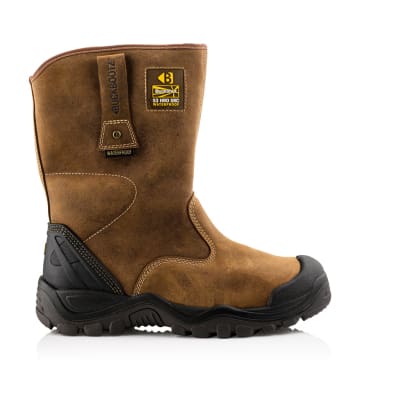
The BSH010 Buckboot Rigger S3 HRO SRC WRU Brown Safety Rigger Boot (£116.80) is the fully-specified workhorse - S3 waterproofing, heat-resistant outsole, top-level slip resistance and a water resistant upper. If you want one rigger that handles everything, this is it.
The B701SMWP Buckbootz Tough as Nails Crazy Horse Leather Goodyear Welted Waterproof Safety Rigger Boot (£123.50) is the premium option and the most heavily built boot in the range. Crazy Horse leather is a waxed full-grain that develops a patina with wear and takes a beating. Goodyear welted, so resoleable. This is a boot bought by someone who intends to keep it for years.
There is also the Buckboots S3 Composite Safety Dealer Boots with Ladder Grip, Pull On (£60.00), which is named as a dealer boot but pulls on like a rigger. Composite rather than steel, so metal-free, and the ladder grip is a specific advantage for anyone spending time on rungs. At £60 it is the cheapest pull-on Buckler in the range.
Dealer Boots: The Middle Ground
If your site has banned riggers but you still do not want laces, a dealer boot is the answer. Dealer boots pull on using elasticated side gussets, sit at ankle height rather than calf height, and are generally accepted where riggers are not.
Buckler's dealer range is the deepest part of their line-up.
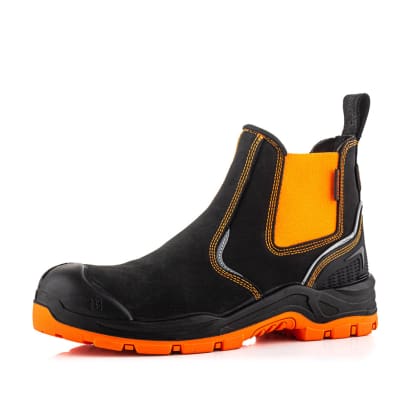
The BVIZ3 Buckboot BuckzViz S3 360 degree High Visibility Metal Free Waterproof Safety Dealer Boot (£69.30) is the value pick and the only 360 degree hi-vis dealer boot here. Metal free, so it clears detectors.
The BSH006 Buckshot S3 HRO SRC WRU Brown Safety Dealer Boot (£82.50) and the BSH014 Buckboot S3 HRO AN SRC Waterproof Safety Dealer Boot (£83.20) are the well-specified mid-range options, the BSH014 adding ankle protection.
The B1150 Buckflex Safety Dealer Boot in Brown Oil (£89.80) and the B1555 Buckbootz Tough as Nails SB P HRO SRC Light Brown Safety Dealer Boot (£89.00) sit close together in price with different priorities - Buckflex prioritising flexibility, Tough as Nails prioritising durability.
The B1151 Buckbootz Tough as Nails Safety Dealer Boot in Light Brown (£91.50), the Buckboot Waterproof Dealer Boot with Goodyear Welted Construction (£98.00) and the B1990 Buckbootz Rugged Safety Dealer Boot in Dark Brown with Goodyear Welted Construction (£101.80) are the premium end - all Goodyear welted and built to be resoled.
Lace-Up and Hiker Styles
For sites that require proper ankle support, Buckler's lace-ups are worth a look.
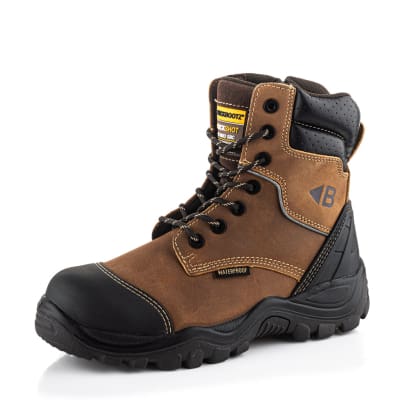
The Composite Buckbootz Nubuckz S3S Safety Lace Boot (£60.00) is the entry point and the cheapest Buckler lace-up. The Buckler BLITZ Waterproof Composite Lightweight Safety Boot (£69.00) prioritises low weight.
The BVIS2 Buckboot High Visibility Metal Free Waterproof Safety Boot (£77.10) and the BVIS1 Buckler High-Visibility Composite Waterproof Safety Lace/Zip Work Boot (£90.50) cover hi-vis requirements, the BVIS1 adding a side zip so you can lace it once and then zip in and out.
For hiker profiles, the BSH002 Buckbootz Buckshot S3 Brown Hiking Style Waterproof Safety Lace Boot (£89.80) and the BSH009 Buckboot Buckshot S3 Waterproof Safety Hiking Boot (£93.00) give better ankle support on uneven ground than any pull-on can.
The B301 Buckbootz Tough as Nails SB P HRO SRC Chocolate Oil Leather Goodyear Welted Safety Lace Boot (£89.00), the B750 Buckbootz Hardwearing Waterproof Goodyear Welted Safety Lace Boot (£88.00) and the BSH012 Buckboot Buckshot Composite Safety Boot with Ankle Protection (£83.00) cover the general site lace-up requirement.
At the top, the BSH008 Buckler Boots Buckshot S3 HRO SRC WRU Dark Brown High Leg Safety Zip Lace Boot (£106.50) and the BVIZ 6 BuckzViz High-Leg Lace Boot in Black and Orange (£95.00) offer high-leg protection with lacing - the closest you get to rigger coverage with rigger-beating ankle support.
Wellingtons and Trainers
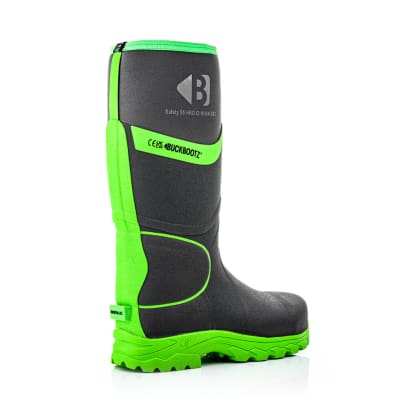
The BBZ6000 Buckboot Neoprene-Rubber Heat and Cold Insulated Safety Wellington (£99.00) is the insulated option for wet, cold groundwork. The BBZ8000 Buckbootz S5 360 degree High Visibility Neoprene/Rubber Safety Wellington with Ankle Protection (£112.60) adds hi-vis and ankle protection - the most specified welly in the range.
The KEZ Buckbootz Tradez S1 P HRO SRC Black Safety Trainer Shoe (£60.00) is the only trainer Buckler offer here, for lighter indoor work.
Rigger Boots From Other Brands
If Buckler is above your budget, the wider rigger range covers the lower price points.
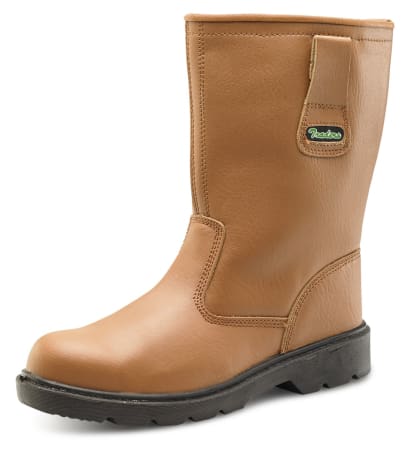
The Beeswift RBUS Leather Upper Unlined Rigger Safety Boot S1P SRC (£28.00) and the Portwest FW13 Rigger Safety Boot S1P with Scuff Cap (£28.35) are the cheapest riggers worth buying. The RBLSSC Lined Rigger Boot Full Safety with Scuff Cap S1P SRC (£28.00) and the CF8 Premium Leather Rigger Safety Boot Tan S1P Lined (£29.19) add a lining for winter.
Moving up, the Beeswift RBLS Leather Upper Fur Lined Rigger Boot S1P SRC (£29.77) is the warmest budget option, the Portwest FW06 Unlined Rigger Safety Boot S1P HRO (£32.13) adds heat resistance, and the Beeswift CTF28 Thinsulate S3 Safety Rigger Boot in Tan (£35.00) brings genuine S3 waterproofing with Thinsulate insulation.
The Portwest FW29 Steelite Black Rigger Boot with Scuff Cap S3 (£36.33) is a solid mid-range S3 rigger.
At the upper end, the Apache AP305 S3 Leather Waterproof Safety Rigger Boots in Brown (£52.00), the Amblers FS124 Lined Rigger Safety Work Boot S3-SRC in Tan (£53.09) and the Amblers FS142 S3 Safety Scuff Cap Rigger Boot (£56.00) are the best value fully-specified riggers.
The JCB Denstone Composite Rigger Safety Boot (£73.14) is metal free, and the Dunlop Purofort Rigpro Fur Lined Waterproof Rigger Wellington (£74.00) is a hybrid rigger-wellington for the wettest groundwork.
Which Boot for Which Trade
Plant operators and drivers. In and out of a cab constantly, mostly on level ground. A rigger is ideal. The Beeswift RBUS at £28 if budget matters, the BSH010 at £116.80 if it does not.
Groundwork and civils. Wet, muddy, uneven. S3 minimum. The Beeswift CTF28 at £35 or the Amblers FS124 at £53.09. For standing water, the Dunlop Purofort Rigpro.
Scaffolders. Most scaffold contractors require laced boots. The BSH008 high leg zip lace or the BSH002 hiker.
Roadside and highways. Visibility at ground level helps. The BVIZ 5 rigger at £95 or the BVIS1 lace-up at £90.50.
Farm and agricultural. Pull-on convenience with real waterproofing. The BBZ6000 wellington or the Dunlop Purofort Rigpro.
Warehouse and yard. Light duty, level surfaces, on and off all day. The KEZ trainer at £60 or a budget rigger.
Sizing and Fit
Riggers fit differently to laced boots. Because there is no lacing to adjust, the fit is fixed - so getting the size right matters more.
Most people find riggers fit slightly large. If you are between sizes, take the smaller one, because a loose rigger will rub at the heel and there is nothing you can do about it afterwards.
Wear proper work socks when you try them. A thick sock changes the fit noticeably, and thin socks in a rigger will cause blisters.
Goodyear-welted Buckler boots need a genuine breaking-in period. The leather is heavy and it will feel stiff for the first week or two. That is normal and it softens. Do not judge them on day one.
Care and Resoling
Leather riggers last considerably longer with basic care. Clean off mud before it dries, because dried mud draws moisture out of leather and cracks it. Treat with a leather conditioner or dubbin every few months.
Never dry leather boots on a radiator or in front of a heater. Fast drying cracks the leather and separates the sole. Stuff them with newspaper and let them dry at room temperature.
The Goodyear-welted models - the B701SMWP, B301, B750, B1990 and B1180 - can be resoled by a cobbler. If the uppers are sound and the sole has gone, resoling costs a fraction of replacement and is the reason those boots justify their price over three or four years.
Replace any boot when the toe cap has been impacted, the midsole has been punctured, the sole tread is gone, or the upper has split. A damaged safety boot is not a safety boot.
Frequently Asked Questions
Are rigger boots banned on construction sites?
Not universally, but many principal contractors do ban them, citing insufficient ankle support. Check your site induction before buying. Dealer boots are usually acceptable where riggers are not.
Do rigger boots give ankle support?
Less than a laced boot. The high shaft provides some coverage, but without lacing the boot cannot be tightened around the ankle, so the foot moves more. That is the basis of the objection to them.
What is Goodyear welted construction?
The upper is stitched to a welt, which is then stitched to the sole. It is more durable than glued construction and allows the boot to be resoled rather than replaced. It costs more and adds weight.
What does S3 HRO SRC WRU mean?
S3 is water resistance plus a penetration-resistant midsole and toe cap. HRO means the outsole resists 300 degrees of contact heat. SRC is the highest slip resistance level. WRU means the upper itself is water resistant. Together it is a comprehensively specified boot.
Are Buckler boots worth the money?
If you wear out boots annually and want something resoleable, yes - the Goodyear-welted models are built to outlast several pairs of cheaper boots. If you need the lightest possible boot or you replace footwear frequently anyway, a mid-range rigger at £30 to £55 may serve you better.
What size rigger boot should I buy?
Take your normal size, and if you are between sizes go down rather than up. A loose rigger cannot be tightened and will rub. Try them with the socks you actually work in.
Where to Start
For most people the decision is: does my site allow riggers? If yes, and you want convenience over ankle support, a rigger between £28 and £56 covers most requirements, with the Buckler BSH010 at £116.80 as the buy-once option.
If riggers are not permitted, a dealer boot gives you most of the pull-on convenience while satisfying site rules. The BVIZ3 at £69.30 is the value pick.
Browse the rigger boots collection or the full safety boots range. For metal-free options, see non-steel safety footwear, and for the wettest conditions the waterproof safety boots collection.
- Posted in:
- Buckler Boots
- Buying Guide
- Construction PPE
- Dealer Boots
- Goodyear Welted Boots
- S3 Safety Boots
- Safety Footwear
- Waterproof Safety Boots