Skip to content

Knee Pads for Work: The Complete Buying Guide
- by Mike Johnson
View the full range here → Helly Hansen Workwear Collection
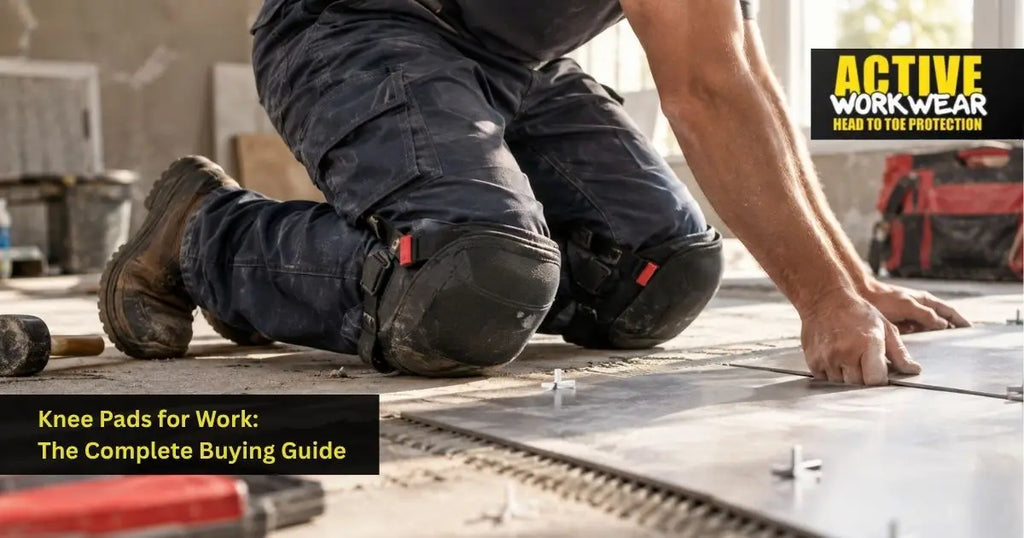
Knee damage is one of the most common long-term injuries in the trades, and one of the easiest to prevent. Flooring, tiling, plumbing, carpentry, electrical work and landscaping all involve hours on your knees, usually on concrete, screed or wet ground.
The frustrating part is that prevention costs very little. A knee pad insert starts under £4. The problem is that most people either buy the wrong type, or buy trousers with knee pad pockets and never get round to buying the pads.
This guide covers the two main types of knee pad, how to choose between gel and foam, what EN 14404 actually means, and which specific products suit which trades - with prices from the Active Workwear range.
Insert Pads or External Pads?
This is the first decision, and it depends entirely on your trousers.
Insert pads slide into purpose-built pockets in the front of knee pad trousers. They sit flat against the knee, stay in position as you move, and you stop noticing them within an hour. They cannot slip, they do not restrict circulation, and there is nothing to catch on scaffolding or ladder rungs.
The catch is that you need trousers with the pockets. Most modern work trousers from Snickers, Blaklader, Apache, Portwest, Helly Hansen and Projob include them, but budget trousers often do not.
External pads strap around the outside of your leg over any trousers. They work with whatever you already own, they can be taken off between tasks, and they generally offer thicker cushioning than an insert. They are the right answer if your trousers have no pockets, or if you only kneel occasionally and would rather not wear pads all day.
The downsides are real though. Straps loosen, pads rotate round your leg, and strapping anything tightly round the back of the knee restricts circulation over a long shift. Cheaper external pads are notorious for sliding down.
The short version: if your trousers have knee pad pockets, use inserts. If they do not, use external pads - or consider that a knee pad trouser plus insert often costs less than a good external pad and works better.
Gel or Foam?
Foam pads are lighter and cheaper. They cushion adequately for occasional kneeling and are perfectly sensible if you are on your knees for twenty minutes a day.
Gel pads spread pressure far more evenly and stay comfortable much longer. If you kneel for hours - floorlayers, tilers, carpet fitters, plumbers working under sinks - gel is worth the extra money and you will notice the difference by the afternoon.
There is a third category worth knowing about. D3O is an impact-absorbing material that stays soft and flexible in normal use but stiffens instantly under impact. It gives you the comfort of a soft pad with the protection of a hard one. Snickers use it across their premium range. It costs considerably more, but for anyone whose knees already give them trouble it is the best option available.
What EN 14404 Means
EN 14404 is the European standard for knee protection for work in a kneeling position. It has four types.
- Type 1 pads are independent of any garment - external strap-on pads.
- Type 2 pads are held in trouser pockets - the insert type.
- Type 3 pads are not attached to the body at all, such as a kneeling mat you place on the ground.
- Type 4 pads are part of a larger device such as a frame or support.
There is also a performance level.
- Level 0 covers flat ground only.
- Level 1 covers flat ground and gravel, and includes puncture resistance up to 100 newtons.
- Level 2 is for demanding conditions with higher puncture resistance.
For most indoor trades, a Type 1 or Type 2 pad at Level 1 is appropriate. For groundwork or anywhere you might kneel on stone, rubble or debris, look for Level 2.
Not every product states a full EN 14404 classification, particularly at the budget end. For most general trades this is not a problem, but if your employer's risk assessment specifies a level, check before buying.
Budget Inserts - Under £8
At this price you are buying basic foam protection, and for occasional kneeling that is genuinely all you need.
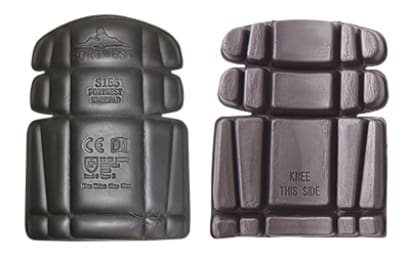
- The Portwest Kneepad Inserts (KP44, £3.71) are CE marked, sold as a pair, and fit any knee pad garment. The cheapest sensible option in the range.
- The Yoko Knee Pad Inserts (WK006, £4.34) fit most kneepad trouser pockets and are similarly straightforward.
- The Portwest Standard Knee Pad Trouser Inserts (S156, £4.97) are a slight step up in build and the most common choice for general trades.
- The Beeswift Foldable Insertable Knee Pad (BBKP08, £5.70) folds flat, which makes it easier to fit into a tighter trouser pocket.
- The Apache Kneepad Inserts (APKNEE, £6.99) are designed specifically for Apache trousers. If you wear Apache, these will fit better than a generic insert.
If you are buying for a team, these are cheap enough to issue as standard alongside trousers rather than treating them as an optional extra.
Mid-Range Inserts - £10 to £25
This is where gel appears and where most people doing regular kneeling work should be looking.
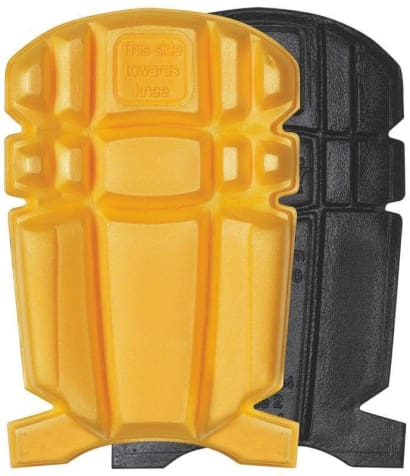
- The Helly Hansen Kneepad Standard Trouser Insert (79569, £10.00) is the correct pad for Helly Hansen trousers.
- The Projob 9033 Gel Foam Knee Pad Inserts (£16.21) combine gel and foam and fit Projob trousers.
- The Blaklader 4027 Knee Protectors for Professionals (£18.18) are a well-regarded all-round pad and one of the better value gel options in the range.
- The Snickers 9110 Knee Pads (£22.85) fit all Snickers work trousers and are the benchmark most tradespeople compare against. If you already wear Snickers trousers, this is the natural pairing.
- For flame retardant environments, the Tranemo Kneepads (91450, £39.90) and the Tranemo 90320 (£28.30) sit within Tranemo's FR range. Tranemo also offer lighter options in the 90200 (£9.10) and 91440 (£10.90). If your work requires certified FR garments, the pads need to be compatible - check with your safety officer rather than assuming a standard pad is acceptable.
Premium Inserts - £29 and Above
If you kneel for a living, this is where the money genuinely changes your working day.
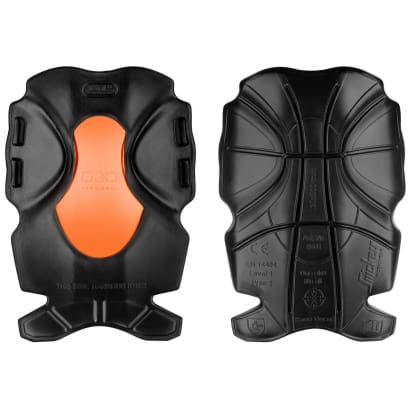
- The Snickers 9112 D3O Lite Craftsmen Kneepads (£29.99) bring D3O impact material into the range at the lowest price point.
- The Snickers 9169 D3O Ergo Craftsmen Kneepads (£39.99) add an ergonomic shape that follows the knee more closely.
- The Fento Insertable Kneepad (35275, £45.00) takes a different approach with a shaped design that distributes load across a wider area. Fento have a strong following among floorlayers specifically.
- The Snickers 9191 XTR D3O Craftsmen Knee Pads (£47.00) are the top of the standard Snickers range and the best all-round premium insert available here.
- For floorlaying specifically, the Snickers 9118 Floorlayer's Bean Bag Kneepads (£51.50) and the Snickers 9119 D3O Lite Floorlayer Kneepads (£54.00) are built for people who spend entire days on their knees on hard floors. The bean bag design conforms to the floor surface rather than compressing against it. At this price they only make sense if kneeling is the majority of your work - but if it is, they are the right purchase.
External Strap-On Pads
If your trousers have no pockets, these are your option.
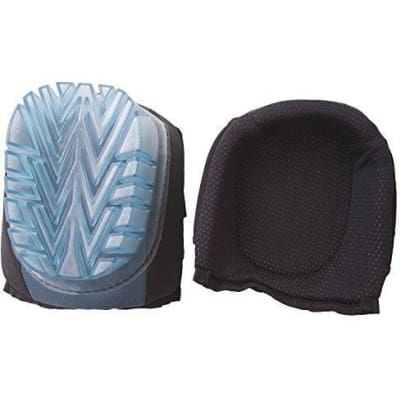
- The Beeswift Hard External Riveted Cap Knee Pad (BBKP02, £6.96) is a basic hard-cap pad for rough surfaces.
- The Portwest Non-Marking External Kneepad (KP50, £6.93) is worth specific mention. The non-marking compound means you can kneel on finished floors, new tiling, laminate or a client's stonework without leaving scuffs. For anyone working in occupied homes or on finished surfaces, this solves a genuine problem.
- The Beeswift PU External Strap On Knee Pads (BBKP01, £9.45) offer a softer PU shell.
- The Portwest Super Gel Filled External Kneepad (KP30, £10.22) and the Portwest Ultimate Gel Filled External Strap-on Kneepad (KP40, £10.64) are the best external options in the range. Gel filling makes a substantial difference to comfort over a long shift, and at around £10 the upgrade over a foam external pad is easy to justify.
For work where you move around constantly rather than staying in one place, a Portwest Kneeling Pad (KP05, £3.83) dropped on the floor is often more practical than strapping anything to your leg. Plumbers and electricians working across multiple locations in a property often prefer this.
Matching Pads to Your Trade
- Floorlaying and carpet fitting. You kneel more than anyone. Gel or D3O inserts, and seriously consider the Snickers 9118 or 9119 floorlayer pads. This is the one trade where the top of the range is justified.
- Tiling. Sustained kneeling on hard, often wet surfaces. Gel inserts such as the Blaklader 4027 or Snickers 9110. If you work on finished floors, the non-marking Portwest KP50 external pad is useful as a second option.
- Plumbing. Intermittent kneeling in awkward positions across a property. Inserts if your trousers take them; otherwise a kneeling pad you can move with you is often more practical than strap-ons.
- Carpentry and joinery. Regular kneeling with a lot of movement between positions. Inserts are better than external pads here because nothing shifts or catches.
- Electrical. Similar to plumbing - lots of short kneeling periods. A basic insert covers it. If you work in occupied properties, the non-marking option protects the customer's flooring.
- Landscaping and grounds work. Kneeling on soil, gravel and stone. Look for Level 2 puncture resistance if available, and gel for comfort on uneven ground. External pads work here because you can take them off when moving between areas.
- Groundwork and civils. Rough, sharp ground. Prioritise puncture resistance over softness. A hard-cap external pad or a Level 2 insert.
Common Mistakes
- Buying knee pad trousers and no pads. The pockets do nothing on their own. Budget for both together - an insert adds under £5 to the cost of the trousers.
- Using generic inserts in brand-specific pockets. Most fit most, but Snickers, Apache, Helly Hansen and Projob pockets are shaped for their own pads. A poorly fitting insert slides down inside the pocket and ends up under your shin.
- Strapping external pads too tightly. Restricting circulation behind the knee causes more problems over a career than the kneeling does. If you need them tight to stay put, the pad is the wrong shape for your leg.
- Choosing foam for heavy kneeling. Foam compresses and stays compressed. For hours of kneeling, gel or D3O is not a luxury.
- Ignoring the surface. A pad rated for flat ground will not protect you from a nail on a stripped floor. Match the performance level to what you actually kneel on.
Frequently Asked Questions
Do knee pads actually prevent injury?
They prevent the pressure damage and bursitis that come from repeated kneeling on hard surfaces, which is the most common knee problem in the trades. They will not protect against twisting injuries or general wear, but the specific damage caused by kneeling is largely preventable.
Which knee pads fit Snickers trousers?
Snickers pads are shaped for Snickers pockets - the 9110 at £22.85 is the standard fit, with the 9112, 9169 and 9191 as premium D3O options. Generic inserts will physically fit but tend not to sit as securely.
What is D3O?
An impact-absorbing material that stays flexible in normal use and stiffens on impact. It gives you soft-pad comfort with hard-pad protection. It appears across the Snickers premium range and costs more than gel or foam.
Are gel knee pads better than foam?
For sustained kneeling, yes. Gel spreads pressure more evenly and does not compress flat the way foam does. For occasional kneeling, foam is perfectly adequate and cheaper.
What does EN 14404 Level 1 mean?
It means the pad is tested for use on flat ground and gravel, with puncture resistance up to 100 newtons. Level 2 offers higher puncture resistance for more demanding conditions. Level 0 is flat ground only.
Can I use external pads over any trousers?
Yes, that is the point of them. They strap over whatever you are wearing. The trade-off is that they can slip or rotate, and tight straps restrict circulation over a long day.
Where to Start
For most tradespeople the sensible route is straightforward. If your trousers have knee pad pockets, buy an insert matched to the brand - around £5 for basic foam, £20 to £25 for gel. If you kneel for hours rather than minutes, go up to gel or D3O and treat it as equipment rather than an accessory. If your trousers have no pockets, a gel external pad at around £10 will serve you far better than a cheap foam one.
Browse the full knee pads collection for inserts and external pads across Snickers, Blaklader, Portwest, Apache, Helly Hansen, Projob, Fento, Tranemo, Beeswift and Yoko. To pair them with the right trousers, see the work trousers range filtered to kneepad trousers, or the workwear shorts collection for summer alternatives.
- Posted in:
- EN 14404
- external knee pads
- gel knee pads
- knee pad inserts
- knee pads
- PPE
- tradesman workwear
- work knee pads